
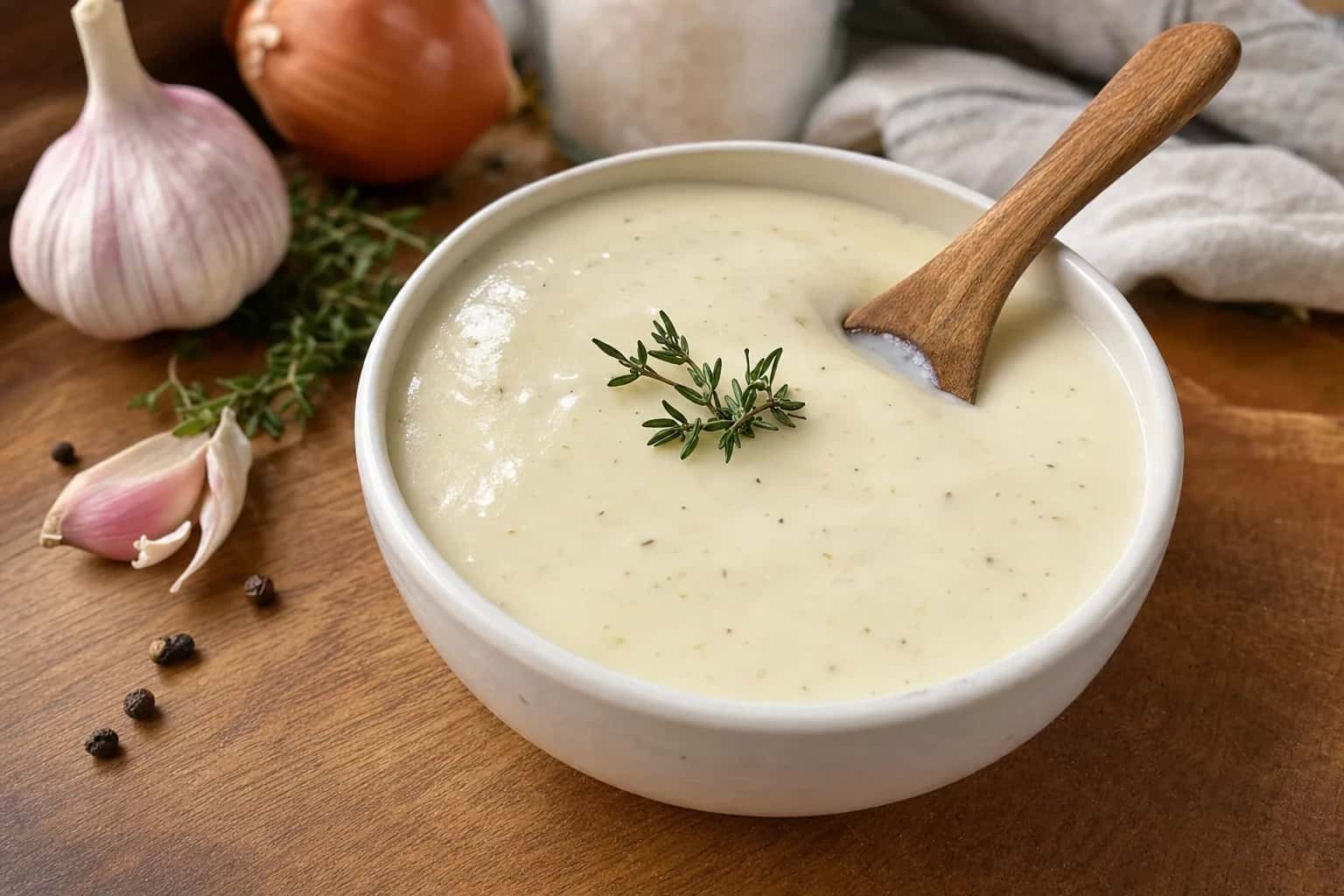
Béchamel Sauce
A smooth béchamel is one of the most useful sauces you can learn. This simple white sauce turns milk, butter, and flour into the creamy base for lasagna, gratins, croque monsieur, and baked pasta.
- Total time
- 17 min
- Yield
- Makes about 2 cups
- Difficulty
- Easy
Prep 5mCook 12mFrenchSide Dishes
Béchamel is a classic French white sauce made from butter, flour, and milk. It starts with a roux, which is just butter and flour cooked together to thicken a sauce.
The method is simple, but the order matters. Warm milk goes into the roux slowly, then the sauce is whisked until smooth and thick enough to coat a spoon.
Use béchamel as a building block. Stir in cheese for a quick cheese sauce, layer it into lasagna, spoon it over vegetables, or use it to make creamy baked dishes without reaching for a can.
01What you'll need
Ingredients
6 items · Makes about 2 cups
- 4 tablespoons unsalted butter
- 4 tablespoons all-purpose flour
- 2 cups whole milk, warmed
- 1/2 teaspoon fine salt, plus more to taste
- 1/8 teaspoon ground white pepper or black pepper
- Pinch of freshly grated nutmeg, optional
02How to make it
Step-by-step
1. Warm the milk
Pour the milk into a small saucepan or microwave-safe jug and warm it until steaming but not boiling. Warm milk blends into the roux more easily and helps prevent lumps.
2. Melt the butter
Set a medium saucepan over medium heat. Add the butter and let it melt fully. It should foam gently, but do not let it brown.
3. Stir in the flour
Add the flour all at once and whisk until no dry flour remains. This paste is the roux. Cook it for 1 to 2 minutes, whisking often, until it smells lightly toasty. Keep it pale for a classic white sauce.
4. Add the milk slowly
Pour in a small splash of warm milk while whisking constantly. The mixture will look very thick at first. Keep adding the milk in small amounts, whisking well after each addition, until about half the milk is mixed in.
5. Whisk in the remaining milk
Add the rest of the milk in a steady stream, still whisking. Scrape around the edges of the pan so no roux sticks in the corners.
6. Simmer until thickened
Bring the sauce to a gentle simmer, then lower the heat. Cook for 5 to 7 minutes, whisking often, until the sauce is smooth and thick enough to coat the back of a spoon.
7. Season and adjust
Whisk in the salt, pepper, and nutmeg if using. Taste carefully and add more salt if needed. If the sauce feels too thick, whisk in a little more warm milk until it reaches the texture you want.
8. Use or hold warm
Use the béchamel right away, or keep it warm over very low heat for a short time. Stir often so a skin does not form on top.
03From our kitchen
Cook's tips
- Make-ahead: Béchamel can be made up to 2 days ahead. Cool it, press a piece of parchment paper or plastic wrap directly onto the surface, and refrigerate in an airtight container.
- Storage: Keep refrigerated for up to 3 days. Reheat gently in a saucepan over low heat, whisking often. Add a splash of milk to loosen it if it has thickened.
- Freezing: You can freeze béchamel for up to 1 month, though the texture may look slightly grainy after thawing. Reheat slowly and whisk well to bring it back together.
- Dairy swap: Whole milk gives the smoothest result, but 2% milk works. For a richer sauce, replace 1/2 cup of the milk with half-and-half.
- Butter swap: If needed, use an equal amount of olive oil instead of butter. The flavor will be less classic but still works for savory dishes.
- Lump fix: If your sauce gets lumpy, keep whisking over low heat. For stubborn lumps, pass the sauce through a fine-mesh sieve or blend it briefly with an immersion blender.
Cook's note
For a thicker béchamel suited to lasagna or croquettes, use 5 tablespoons each butter and flour with the same 2 cups of milk. For a thinner sauce to spoon over vegetables, reduce the butter and flour to 3 tablespoons each.
04Frequently asked
Questions & answers
What is béchamel used for?
Béchamel is used in lasagna, moussaka, vegetable gratins, macaroni and cheese, croque monsieur, and creamy baked pasta. It is also the base for many other sauces.
Why did my béchamel taste like flour?
The roux probably did not cook long enough. After adding the flour to the butter, cook it for 1 to 2 minutes while whisking. This removes the raw flour taste without browning the sauce.
Can I make béchamel without nutmeg?
Yes. Nutmeg is traditional, but optional. A small pinch adds warmth, but the sauce will still be good with just salt and pepper.
How do I turn béchamel into cheese sauce?
Remove the finished sauce from the heat and whisk in 1 to 1 1/2 cups of grated cheese, such as cheddar, Gruyère, or Parmesan. Add the cheese off the heat so it melts smoothly instead of turning grainy.
Why is my béchamel too thick?
It may have cooked a little longer than needed, or the heat may have been too high. Whisk in warm milk, a tablespoon or two at a time, until the sauce loosens.
05Per serving
Nutrition facts
Nutrition Facts
Makes about 2 cups
Amount per serving
% Daily Value*
- Total Fat31 g
- 40%
- Saturated Fat19 g
- 96%
- Cholesterol85 mg
- 28%
- Sodium659 mg
- 29%
- Total Carbohydrate24 g
- 9%
- Dietary Fiber0.5 g
- 2%
- Total Sugars13 g
- Protein9.6 g
- 19%
- Vitamin D3.6 mcg
- 18%
- Calcium285 mg
- 22%
- Iron0.8 mg
- 4%
- Potassium346 mg
- 7%
* Percent Daily Values are based on a 2,000-calorie diet. Values are estimated from the ingredient list; actual amounts vary with brands, portion sizes, and substitutions.
05Keep cooking
You might also like
 Side Dishes
Cilantro Lime Rice
Fluffy long-grain rice gets a bright finish from fresh lime juice, lime zest, and chopped cilantro. Serve it with tacos, beans, grilled chicken, roasted vegetables, or anything that needs a fresh side.
 Side Dishes
Creamed Corn
This cozy creamed corn is rich, gently sweet, and simple enough for a weeknight side dish. Use fresh corn in summer or frozen corn any time of year.
 Side Dishes
Asparagus in the Oven
Roasting asparagus is one of the easiest ways to turn a bunch of green spears into a crisp-tender side dish. All you need is a hot oven, a little oil, salt, pepper, and about 15 minutes.
 Side Dishes
Cilantro Lime Rice
This bright, fluffy cilantro lime rice is a simple side for tacos, grilled chicken, beans, burrito bowls, and weeknight dinners. A little lime zest, fresh juice, and chopped cilantro make plain rice taste fresh without a